Notwithstanding the provisions of the previous paragraphs and other provisions of the Terms of Service, Sato may choose not to conclude a usage contract or usage modification contract with the Service usage applicant or Customer if any of the following apply.
- The party’s Service usage contract has been cancelled due to non-performance of financial obligations or other violations of the usage contract, etc.
- The party has entered false or erroneous information in its usage application, or has failed to enter information.
- There is a risk that the party will default on its financial obligations or other obligations based on the usage contract, etc.
- Any other matters which Sato deems improper.
In order to apply for use, Sato may require the applicant to submit a separate application form, etc.
Article 10 Use by Authorized Users
The Customer may, when given approval using the methods set forth by Sato, have an Authorized User use the Service. When doing so, the Customer agrees that the use of the Service by the Authorized User shall be considered to be use by the Customer, and the Customer shall bear all responsibility for matters related to the use of the Service by any Authorized User.
Article 11 Change notice
- In the event of a change to the title, name, head office location or head office address, contact information, or other matters pertaining to the Customer that issued the application, the Customer shall provide notice to Sato of said change or changes in advance using the method stipulated by Sato.
- Sato cannot be held in any way responsible for any damages resulting from the inability to provide notices or any other matters arising as the result of the Customer’s failure to provide notice regarding the matters in the previous paragraph.
Article 12 Temporary Interruption and Suspension of Service
-
Sato may, in the following circumstances, interrupt the provision of the Service to the Customer without prior notice or approval.
- Maintenance in response to outages to Service equipment, etc.
- When unavoidable for operational or technical reasons
- When unable to provide the Service due to natural disasters or other events of force majeure
- Sato may temporarily suspend provision of the Service after providing advance notice to the Customer in order to perform regular inspections of Service equipment, etc.
- Sato may stop provision of the Service, in whole or in part, without prior notice or formal demand to the Customer, in the event that any of the items in Article 15 (Termination of the Usage Contract by Sato) paragraph 1 apply to the Customer, or if the Customer has violated any other parts of the usage contract, etc.
- Sato cannot be held in any way responsible for any damages suffered by the Customer, etc. or a third party as the result of Sato not providing the Service due to any of the circumstances indicated in the preceding paragraphs.
Article 13 Term
- The term of the Service shall extend until the end of the plan selected by the Customer when applying for the Service. If neither Sato nor the Customer indicates their intent otherwise by the end of the term (if the last day of the term is a weekend or holiday, then the following business day) via the methods specified by Sato, the term shall be renewed automatically. This clause shall also apply to all subsequent terms.
- Sato may change the usage contract contents of the Service for the term following a renewal by providing the Customer with notice of the contents of the changes to the usage contract before the date on which the changes to the Service are to go into effect. Sato may not be held in any way responsible for any adverse effects or damages suffered by the Customer as the result of changes to the Terms of Service.
Article 14 Termination of the Usage Contract by the Customer
A User wishing to discontinue use of the Service must use the cancellation procedures stipulated by Sato. The User shall lose its qualification as a User in accordance with the Terms of Service when a usage termination notice is issued by Sato via email, etc. However, the Terms of Service shall still apply to usage of the Service until the User loses its qualification.
Article 15 Termination of the Usage Contract by Sato
Sato may cancel the usage contract, in whole or in part, without prior notice or formal demand to the Customer, in the event that it deems that any of the below apply to the Customer.
- The Customer has entered false information in its usage application, or has failed to enter information
- The Customer has stopped making payments or become unable to make payments
- The Customer issues a dishonored bill or check
- The Customer’s assets are seized or provisionally seized or a petition is issued for a compulsory asset auction, or are coercively collected for the payment of taxes and public dues
- The Customer moves to initiate bankruptcy proceedings, corporate reorganization proceedings, or civil rehabilitation proceedings, or its credit status has become highly unstable
- The Customer’s license to do business is rescinded or suspended, etc. by supervisory authorities
- Due to a violation of the usage contract, etc., a formal demand has been issued to the Customer to redress the violation, but the violation has not been redressed within a reasonable period of time following the formal demand
- The decision has been made to dissolve the Customer, reduce its capital, or transfer part or all of its operations, etc.
- Matters have occurred which make it difficult for the Customer to satisfy the terms of the usage contract
Article 16 Cancellation of the Service
Sato may cancel the Service, in whole or in part, if any of the following apply, and may cancel the usage contract, in whole or in part, as of the date of the cancellation of the Service.
- When the customer is notified of the cancellation of the Service at least 180 days in advance
- When Sato is unable to provide the Service due to natural disasters or other force majeure
Article 17 Processes following the End of the Contract
- Following the end of the usage contract, the Customer shall immediately return the devices, software, and all related materials, etc. provided by Sato for the use of the Service (including partial and complete copies of said software and materials, etc,. the same shall apply hereafter) to Sato, and the Customer shall be responsible for deleting all software and materials, etc., stored in Customer equipment, etc.
- Sato may delete magnetic data recorded in Service equipment, etc., following the end of the usage contract, at the time and using the methods prescribed separately by Sato.
Part 3 Service
Article 18 Contents of the Service
- The contents of the Service shall be as defined in Attachment A.
-
The Customer shall agree to the matters in the following items before using the Service.
- The Service may experience malfunctions that are not caused by Sato, including those indicated in each item of Paragraph 1 of Article 36 (Disclaimers)
- Sato cannot be held in any way responsible for Service malfunctions that are not caused by Sato
-
The contents of the Service shall be set forth in the usage contract, and the following shall not be supplied to the customer unless explicitly added to the usage contract.
- Inquiry support or troubleshooting, etc., related to software and/or hardware
- Supplying of data storage media, ink ribbons, paper, or other supplies
- Handling of inquiries regarding the content of or changes to data pertaining to the Service
- The Customer may use the Service as stipulated in the usage contract, etc., and accepts that the Customer will not acquire intellectual property rights or other rights related to the Service.
- Sato does not guarantee the Customer that the Service is fully compatible with specific work performed by the Customer.
Article 19 Region in Which the Service is Provided
The Service shall be provided in the countries which the Sato accepts prior to the execution of the individual contract.
Article 20 Subcontractors
Sato may subcontract operations, in whole or in part, required for the provision of the Service to the Customer, to a third party at the sole discretion of Sato. When doing so, Sato shall require the subcontractor (“Subcontractor”) to meet obligations equivalent to the obligations of Sato as stipulated in Article 32 (Handling of Confidential Information), Article 33 (Handling of Personal Information), and other obligations set forth in the usage contract, etc. regarding the execution of duties by the Subcontractor.
Part 4 Usage Fees
Article 21 Service Usage Fees
Except as otherwise provided in the usage contract, etc., the usage fee for the Service is free.
Part 5 Customer Obligations, etc.
Article 22 Indemnification
- The Customer shall indemnify, defend, and hold harmless Sato and its officers, directors, employees, agents, affiliates, successors and assigns (collectively, the “Sato Indemnified Parties”) against any and all losses, damages, liabilities, deficiencies, claims, actions, judgments, settlements, interest, awards, penalties, fines, costs or expenses of whatever kind, including reasonable attorneys’ fees, incurred by a Sato Indemnified Party (collectively, “Losses”) resulting from any claim alleging any bodily injury, death of any person, or damage to real or tangible personal property, except to the extent such Losses are the result of the gross negligence or willful misconduct of the Sato Indemnified Parties.
- If Sato becomes aware of any Losses in accordance with the foregoing paragraph, Sato shall provide prompt written notice to the Customer; provided, that any delay in providing such notice shall not affect the Customer’s indemnification obligations hereunder unless the Customer is materially prejudiced thereby. The Customer shall be solely responsible for the costs of defending any legal proceeding in connection with such Losses, with counsel reasonably acceptable to Sato; provided, that Sato may elect to retain separate counsel at its sole expense. The Customer shall have no power to settle a claim for any Losses without the prior written consent of Sato, which may be withheld in Sato’s sole discretion.
- The Customer shall be responsible for the information provided by or transmitted by the Customer, etc. using the Service. Sato does not make any guarantees regarding its contents, etc. Sato cannot be held in any way responsible for damages resulting from said information.
Article 23 Usage Manager
- The Customer shall select a Usage Manager responsible for the use of the Service and shall notify Sato of the Usage Manager by filling out the usage application stipulated in Article 9. Contact and confirmation, etc., with Sato regarding the use of the Service shall, as a rule, be conducted through the Usage Manager.
- If the Usage Manager is changed to a person other than the Usage Manager indicated in the usage application, the Customer shall promptly notify Sato.
Article 24 Configuration and Maintenance of Equipment Used by the Service
- The Customer shall be responsible for configuring its own equipment, at its own expense, in accordance with the configuration conditions stipulated by Sato, and for maintaining, at its own expense, the Customer equipment and the environment used by the Service.
- The Customer shall, in order to use the Service, be responsible for connecting Customer equipment to the Internet, at the Customer’s expense, using a telecommunications service provided by a telecommunications provider, etc.
- In the event of problems affecting Customer equipment, the Internet connectivity set forth in the preceding paragraph, or the environment used to use the Service, Sato is not obliged to provide the Service to the Customer.
- When Sato deems it necessary from a maintenance, operational, or technical perspective, Sato may monitor, analyze, inspect, or perform other actions on the data, etc. provided or transmitted by the Customer via the Service.
Article 25 Login ID and Password
- The Customer shall not disclose, lend, or share its Login ID or Password with a third party except in the case of an Authorized User as stipulated in the usage contract, etc. This information shall be managed closely to prevent leakage to third parties (this includes appropriate changing of the Password). Sato cannot be held in any way responsible for any damages suffered by the Customer or any third parties as the result of mismanagement, misuse, third-party use, etc. of the Customer’s Login ID or Password. All use of the Service and all other actions taken using the Customer’s Login ID or Password shall be treated as use by the Customer.
- If a third party uses the Service using the Customer’s Login ID or Password, all said actions shall be considered to be actions taken by the Customer. If Sato suffers damages as the result of these actions, the Customer shall be responsible for compensating Sato. However, this shall not apply if the use of the Login ID or Password by a third party were the result of the gross negligence or willful misconduct of Sato.
Article 26 Backup
The Customer shall be responsible for backing up any data, etc. provided or transmitted by the Customer, etc. using the Service. Except when the usage contract stipulates that Sato will provide backup services for data, etc., Sato shall not be responsible for storing, saving, or backing up, etc., said data.
Article 27 Prohibitions
-
The Customer shall not engage in the following conduct in relation to the use of the Service.
- Conduct that violates or has the potential to violate the copyrights, trademark rights, other intellectual property rights, or other rights of Sato or any third party
- The duplication, distribution, tampering, or deletion of Service contents or information which can be used by the Service
- Allowing use of the Service by a third party in violation of the usage contract, etc.
- Illegal conduct, conduct that violates public order and standards of decency, or conduct that produces adverse effects for Sato or any third party
- Conduct which discriminates against, defames, disparages, or discredits others
- Conduct which is linked to or has the potential to be linked to fraud or other crimes
- The transmission or posting of indecent, child pornography or child abuse images or documents, etc.
- The opening of or solicitation of participation in pyramid schemes
- Use of the Service while impersonating a third party
- The transmission or posting of viruses or other harmful computer programs, etc.
- The transmission of advertising, promotion, or solicitation emails to third parties without permission, or the transmission of distasteful or potentially distasteful email to third parties (abusive email)
- Conduct which interferes with or has the potential to interfere with the use or operation of third party equipment, etc. or Service equipment, etc.
- Linking to conduct to which any or all of the preceding items apply with the appearance or purpose of encouraging said conduct
- If the Customer discovers that any of the conduct set forth in the items in the preceding paragraph has or may have occurred, the Customer shall immediately notify Sato.
- If Sato discovers that, in the use of the Service, the Customer, etc. has engaged in any of the conduct indicated in the items in Paragraph 1, or the information provided to the Customer, etc., has been involved in any of the conduct indicated in the items in Paragraph 1, Sato may temporarily suspend provision of the Service, in whole or in part, without prior notice to the Customer, and may delete any information related to the conduct indicated in the items in Paragraph 1. However, Sato shall not be responsible for monitoring the conduct of the Customer, etc., nor shall it be responsible for monitoring information (including data and content) provided or transmitted by the Customer, etc. (including information considered as being used by the Customer).
Article 28 Authorized User Compliance Items, etc.
-
In accordance with the stipulations of Article 10 (Use by Authorized Users), if Sato approves the use of the Service by an Authorized User, the Customer shall conclude a contract with the Authorized User defining the following matters, and the Customer shall ensure that the Authorized User complies with these stipulations.
- The Authorized User agrees to the contents of the usage contract, etc. and complies with them in the same way as the Customer.
- If the usage contract between the Customer and Sato is ended, for any reason, the provision of the Service to the Authorized User will also automatically end, and the Authorized User will be unable to use the Service.
- The Authorized User shall not allow the use of the Service by any third party.
- If Sato deems it necessary with regard to the provision of the Service, the Customer may disclose confidential information to Sato to the extent that it is necessary without prior written approval from the Authorized User. Sato may also disclose confidential information to subcontractors designated in Article 20 (Subcontractors), to the extent that it is necessary to do so for subcontracting, without prior written approval from the Customer. However, Sato shall be responsible for managing said confidential information in the same manner as the confidential information set forth in the Terms of Service.
- The Authorized User shall recognize that it cannot in any way pursue the liability of Sato in relation to the Service, including making claims for damages, etc., regardless of the reason for the claims, and the Authorized User shall not in any way pursue the liability of Sato.
- The Customer shall promptly convey to the Authorized User any notices or other contact from Sato regarding the Service.
Article 29 Measures to be Taken in the Event of Violations of the Usage Contract by the Authorized User
- In accordance with the stipulations of Article 10 (Use by Authorized Users), if Sato approves the use of the Service by an Authorized User, and the Authorized User violates any of the stipulations set forth in the items in Paragraph 1 of the preceding article, the Customer shall promptly rectify this violation.
-
If the Authorized User violates any of the stipulations set forth in the items in Paragraph 1 of the preceding article, and has not rectified this violation within 30 days of the date of the violation, Sato may implement any of the following actions.
- Suspension of the provision of the Service to the Authorized User
- Cancel the entire usage contract between Sato and the Customer, or cancel part of the usage contract between Sato and the Customer, including the part which includes the use of the Service by the Authorized User.
Part 6 Sato’s Obligations, etc.
Article 30 Commercially Reasonable Efforts
Except as otherwise provided in the usage contract, etc., Sato shall use commercially reasonable efforts to provide the Service during the Term.
Article 31 Service Equipment, etc. Failures
- When Sato discovers that a failure has occurred in Service equipment, etc., it shall promptly notify the Customer.
- When Sato discovers that a failure has occurred in Service equipment installed by Sato, it shall promptly repair or restore the Service equipment.
- When Sato discovers a failure in a telecommunications circuit rented by Sato and connected to Service equipment, included within the Service equipment, etc., it shall instruct the telecommunications provider to repair or restore the telecommunications circuit.
- In addition to the above, in the event of a failure affecting the Service, both Sato and the Customer shall promptly notify each other, decide through mutual consultation what measures each shall take, and implement said measures.
Part 7 Handling of Confidential Information, etc.
Article 32 Handling of Confidential Information
-
The Customer and Sato shall not disclose or leak to any third party any technical, sales, or other operational information which it receives from the other party during the course of Service provision, and which the other party has designated in advance in writing as confidential information, has specified the scope of the confidential information when providing, and has clearly indicated as confidential information (hereinafter referred to as “confidential information”). The party that receives confidential information is hereinafter referred to as the “Recipient.” However, this shall not apply when permission is granted by the other party in written form in advance, or when any of the following applies to the information.
- Information already in the possession of the Recipient at the time of disclosure, and which the Recipient has received without incurring the duty of confidentiality
- Information which the Recipient has received from a third party without incurring the duty of confidentiality
- Information developed on its own by the Recipient without use of the information received from the other party
- Information that has already been made public knowledge without the Recipient violating the usage contract, etc., regardless of whether the information was made public knowledge before or after being received
- Information that was provided without designating the scope of confidentiality, or the fact that the information is confidential, as stipulated in this article
- Notwithstanding the above, in accordance with legal requirements or when requested by government or public offices with proper authority to disclose confidential information, the Recipient may disclose confidential information to information disclosure recipients stipulated in said laws or to said government and public offices. When doing so, the Recipient shall notify the other party before disclosing the information provided that doing so is not a violation of law. If the Recipient is unable to provide notice before disclosing the information, the Recipient shall provide notice promptly after disclosing the information provided that doing so is not a violation of law.
- The Recipient shall take all commercially reasonable actions necessary to secure the confidentiality of confidential information against unauthorized disclosure or access.
- The Recipient shall only use confidential information received from the other party for the purposes of the Service, and may duplicate or modify (hereinafter referred to within this clause as “duplication, etc.”) materials, etc. which contain said confidential information within the scope for which it is required for the Service (hereinafter referred to within this clause as “Materials, etc.”). The Recipient shall handle confidential information which has been duplicated, etc., as confidential information as stipulated in this article. When duplication, etc., is required beyond the scope for which the information is required for the Service, written approval must first be received from the other party.
- Notwithstanding the above stipulations, when Sato deems it necessary to do so, it may disclose confidential information to a subcontractor as stipulated in Article 20 (Subcontractors) to the extent that the confidential information is required for subcontracting, without receiving prior written approval from the Customer. When doing so, Sato shall impose on the subcontractor the same duty of confidentiality as that imposed on Sato.
- When requested by the other party, the Recipient shall return Materials, etc. (including confidential information duplicated or modified with the approval of the other party as stipulated in Paragraph 4 of this articles) to the other party, and if any confidential information is contained in Customer equipment or Service equipment, shall delete all said confidential information.
- The stipulations in this article shall remain in effect for a period of two years following the termination of the Service.
Article 33 Handling of Personal Information
Sato shall appropriately manage all personal information received from the Customer in relation to the provision of the Service (defined identically to the “personal information” defined in the applicable laws, and including personal information received from affiliated companies).”) in accordance with Sato’s Privacy Policy (see https://www.sato-global.com/privacy for details). Sato may, in accordance with the stipulations of the Privacy Policy, the following article, the applicable laws, transfer personal information received from the Customer to and store said information in a Sato site in a country other than the country in which the Customer is located.
Article 34 Compliance with Privacy Laws
Sato and the Customer shall comply with all applicable laws, rules and regulations governing the collection, disclosure, use, sale or other sharing of personal information of individuals.
Article 34-B Compliance with Privacy Laws (USA)
In the event that Customer intends to transfer personal information or data as defined in the California Consumer Privacy Act, (including any personal information of the Customer’s employees) obtained within the United States to a site of business of Sato located outside the United States for use with the Service, the following shall apply:
Obligations of the Customer:
- Customer shall provide sufficient advance explanation to the owner of the personal information regarding the purpose of transferring the personal information, and obtain approval from the owner regarding the transfer.
- If the owner of the personal information requests that such personal information be corrected or deleted, Customer shall promptly notify Sato.
Obligations of Sato:
- Sato shall ensure appropriate security measures to prevent unauthorized disclosure of or access to personal information.
- Sato shall promptly correct or delete personal information if requested in writing by the Customer.
- Sato shall keep internal records on how it processes personal information for the purpose of offering the Service.
- If Sato identifies any unauthorized disclosure of or access to personal information transferred for use with the Service, Sato will promptly notify Customer and cooperate in notifying the owner of the personal information and any supervisory authority of such disclosure or access in accordance with applicable law.
Article 34-C Compliance with Privacy Laws (GDPR)
In the event that Customer intends to transfer personal information or data as defined in the EU General Data Protection Regulation (GDPR) (including any personal information of the Customer’s employees) obtained within EU and the European Economic Area (EEA) to a site of business of Sato located outside EEA for use with the Service, “Obligation of the Customer” and “Obligation of Sato” in Article 34-B shall apply mutatis mutandis.
Part 8 Compensation for Damages, etc.
Article 35 Limitation of Liability for Damages
- Disclaimer. IN NO EVENT SHALL SATO BE LIABLE TO THE CUSTOMER OR TO ANY THIRD PARTY FOR ANY LOSS OF USE, REVENUE OR PROFIT, LOSS OF DATA, LOSS OF USE, LOSS OF BUSINESS OR DIMINUTION IN VALUE, OR FOR ANY INCIDENTAL, SPECIAL, INDIRECT, PUNITIVE, EXEMPLARY OR CONSEQUENTIAL DAMAGES OF ANY KIND, WHETHER ARISING OUT OF BREACH OF CONTRACT, TORT (INCLUDING NEGLIGENCE), OR OTHERWISE, REGARDLESS OF WHETHER SUCH DAMAGE WAS FORESEEABLE AND WHETHER OR NOT SATO HAS BEEN ADVISED OF THE POSSIBILITY OF SUCH DAMAGES, AND NOTWITHSTANDING THE FAILURE OF ANY AGREED OR OTHER REMEDY OF ITS ESSENTIAL PURPOSE.
- In the event that an Authorized User suffers damages related to the Service or the usage contract, etc. due to a matter for which Sato is responsible, or due to a violation of the usage contract, etc. by Sato, Sato’s responsibility to the Customer, stipulated above, shall be considered as absolving Sato from any responsibility to the Authorized User, and the Customer shall be responsible for satisfying any and all claims of the Authorized User.
Article 36 Disclaimers
-
Sato’s liability with relation to the Service and usage contract, etc. shall be limited as stipulated in the previous article, regardless of the circumstances. Without limitation to the provisions of Paragraph 1 of Article 35, Sato shall not be liable for damages to the Customer resulting from any of the following, regardless of the reason for the claim, be it liability for non-performance of a material obligation, tort liability, or other legal liability.
- Natural disasters, strife, riots, or other force majeure
- Failures in Customer equipment or in Customer connectivity environments, such as failures in internet connectivity services providing connectivity to Service equipment
- Damages caused by Internet connectivity service performance values such as response time from Service equipment
- The infection of Service equipment with a computer virus that is not included within virus patterns, virus definition files, etc., provided by a third party that provides the antivirus software installed by Sato
- Unauthorized access, attacks, or eavesdropping on Service equipment, etc. by a third party that could not be prevented despite the exercise of the due care of a good manager
- Damages resulting from a failure of the Customer, etc. to implement the procedures and security methods, etc., stipulated by Sato
- Damages resulting from Service equipment software (OS, middleware, DBMS) and databases not involving manufacturing by Sato
- Damages resulting from Service equipment hardware not involving manufacturing by Sato
- Damages resulting from failures in the provision of telecommunications services by a telecommunications provider
- Compulsory legal disposition in accordance with the stipulations of Article 218 (Seizure, Search, or Inspection upon a Warrant) of the Code of Criminal Procedure, the Act on Wiretapping for Criminal Investigation, or other court orders or laws
- Accidents such as loss of deliverables during transport due to circumstances for which Sato is not responsible
- Subcontractor operations for which Sato does not bear responsibility in the form of negligence with respect to the selection or supervision of subcontractors, etc.
- Other matters for which Sato is not responsible
- Sato shall not be held in any way responsible for disputes arising between the Customer and a third party as the result of the use of the Service by the Customer, etc.
Article 37 Service Level
- Sato shall provide the Service by making commercially reasonable effort in order to meet the standards indicated in Attachment A “Operation Management Indices” (hereinafter referred to as the “Operation Management Indices”).
- Sato may modify the Operation Management Indices provided that said modifications do not affect the contents of the Service as stipulated in the Terms of Service. The modified Operation Management Indices shall be applied from the date stipulated by Sato.
- The Operation Management Indices consist of Sato’s Service targets. Sato shall not be held responsible for damages or any other results of actual values falling below the target values indicated in the Operation Management Indices.
- The Operation Management Indices do not apply to any services excluded from the Terms of Service, nor are they applied to any problems resulting from issues indicated in the disclaimers.
The supplemental provisions to these terms, and their dates of application, are as indicated below.
| Version |
Supplemental Provisions / Date of Application |
| Ver. 1.0 |
October 1, 2024 |
|
|
|
|
|
|
|
|
|
|
|
|
Attachment A
The contents of the Service shall be as indicated below.
1. Contents of Service
1.1. Overview of the Service
Sato provides the Service that centrally manages Customer’s ID information used in cloud services and software provided by Sato. Customer can use Sato's cloud services and software connected to the Service with common ID information.
2. Operation system
2.1.Division of roles
The division of roles in the operation of the service shall be as indicated below.
| Division |
Role |
| Contracting party (Customer and Authorized User) |
* Handling of inquiries from individual users |
| Helpdesk (Sato) |
* Handling of inquiries from the Customer (initial reception) |
| System monitoring |
* System information acquisition |
| (Sato) |
* Hardware, middleware, and service monitoring |
| Liaison |
* Liaising with the Customer |
| (Sato) |
* Fault response (overall control) |
2.2. Operation responsibility scope
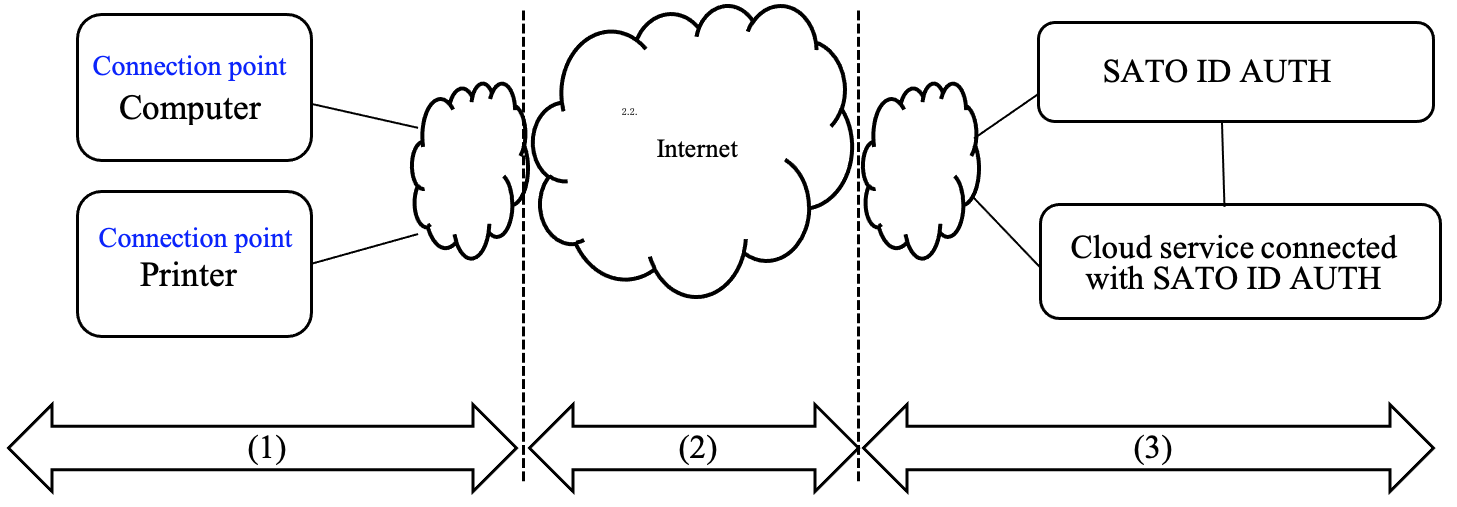
* “Connection point” can be used to refer to either the contracting party or the connected device.
The operation responsibility scope of Sato and the connection points is defined below.
| Scope |
Sato |
Connection point |
| (1) Connection points, wireless environment, cloud and internet connectivity environment |
- |
〇 |
| (2) Public network (carrier responsibility scope)/internet (ISP responsibility scope) |
- |
- |
(3) Sato Data Center
(data center environment, server, internal network, internet connectivity environment) |
〇 |
- |
* The “(2) Internet” section is managed by carriers and other providers, so Sato is unable to investigate transmission speeds and failures in this section.
* Connection points (printers) will be added in a later release.
3. Routine service operation
3.1. Service operation times
The service operation times are defined as below.
| Scope |
Days of operation |
Hours of operation |
Notes |
| The Service |
365 days a year |
24 hours a day |
|
* If the system needs to be shut down for system maintenance, etc., Sato will notify the Customer in advance.
* In the event of emergency maintenance, the system may be shut down without prior notice.
3.2. Contact point operating hours
| Item |
Standard operating hours |
Notes |
| Helpdesk |
Sato business days |
The hours at left may not apply in the event of system shutdowns or other outages. |
| System monitoring |
24 hours a day, 365 days a year |
| Sales |
Sato business days. |
3.3. Routine operation
-
Routine monitoring
| Monitoring |
Contents |
| Infrastructure |
Server operation confirmation, network connectivity confirmation Resource threshold monitoring, process operation confirmation |
| Service |
Status confirmation via reference screen in the event of an inquiry |
-
Problem management
| Operating item |
Contents |
| Problem detection through monitoring |
* Problem detection and record-taking
* Primary problem point identification when an abnormality is discovered and notification to device vendors, etc.
|
| Outage information collection and |
Outage investigation, information collection, and analysis |
| analysisOutage handling |
Outage handling when an abnormality is detected by the data center |
| Reoccurrence prevention meeting |
System and operation-related issue handling following the handling of an abnormality |
-
Change and resource management
| Operating item |
Contents |
| Change and resource management |
Change and resource management for system software, application software, server devices, and networks
For upgrades, application of critical patches after critical patch verification.
Application of function improvement upgrades as appropriate.
|
-
Configuration management
| Operating item |
Contents |
| Maintenance and management |
Maintenance and management of system software, application software, hardware, networks, and facilities |
-
Capacity management
| Operating item |
Contents |
| Resource monitoring |
Monitoring of server CPU utilization rates, memory utilization rates, disk utilization rates, network traffic, etc. |
| Resource management |
Formulation and implementation of resource plans |
-
Availability management
| Operating item |
Contents |
| Server monitoring |
Server alive monitoring |
| Process monitoring |
Process alive monitoring |
Network monitoring |
Network alive monitoring |
| Job monitoring |
Application software abnormality monitoring |
-
Data storage
| Scope |
Period |
Deletion timing |
| Number of days of data storage |
All data provided by the Service until the final date of the Service contract |
Upon end of contract |
4. Helpdesk service
| No. |
Item |
Contents |
| 1 |
Inquiries regarding operation |
Reception and response to inquiries from Customer regarding operation of the Service. |
| 2 |
Inquiries regarding Service problems |
Inquiry reception, diagnosis, investigation, problem isolation, cause identification, countermeasure instructions, etc. in response to inquiries regarding problems occurring during use of the Service. |
5. Operation Management Indices
The following are defined as target values in managing and providing the Service.
| Management Item |
Detailed Management Item |
Explanation |
Unit |
Target |
| Availability |
Service time |
Hours during which the Service is provided |
Hours |
24 hours a day, 365 days a year (*1) |
| Planned Service interruption notifi-cation |
Hours during which the Service is unavailable due to planned Service interruptions |
Hours |
As a rule, notification will be provided at least one month in advance (except when emergency Service interruption is required) |
| Service operation rate |
Service operation rate not including planned Service interruptions |
% |
99.9%(*1)(8.76 hours or less of Service down time per year) |
*1 :Not including service interruptions caused by intentional acts or negligence of Service users, planned interruptions, natural disasters, etc.